This July, Taos Land Trust is celebrating the completion of a year of work supported by the New Mexico Water Resources Research Institute’s Agricultural Water Resilience Program, or NM WRRI AgWRP. Funding was awarded through the Vigil y Romo Water Resiliency Project, a collaboration with the official grant recipient, the Vigil y Romo Acequia, and local parciantes working to restore agricultural lands along the Rio Fernando. The work builds on Taos Land Trust’s broader restoration of Rio Fernando Park and the return of acequia-fed farming to land that had been left fallow for decades.
The purpose of the Vigil y Romo Water Resiliency Project was to improve irrigation for a drier future and reduce pressure on groundwater by making better use of acequia water, rainwater catchment, and soil-building practices. Along the way, the project supported improvements to help water move more efficiently to crops and trees, strengthen soil health, and expand community knowledge about water conservation.
Regenerative Results
Project results are already making big impacts. At our office, a completed gravity-fed rainwater catchment system now waters an orchard of 10 fruit trees using roof runoff stored in a 2,500 gallon tank, taking that irrigation zone off well dependence. Both 2,500 gallon tanks were filled to about half capacity during recent rains, and we estimate that another 500 gallons will be collected from the office and wash station roofs during July.
This project also created opportunities for learning and exchange. Elisa Hardy, Water Program Specialist at the Taos Soil and Water Conservation District, led a public workshop on rainwater catchment systems and used our site as a hands-on example, showing participants how water harvesting can work in real conditions along the Rio Fernando and elsewhere.
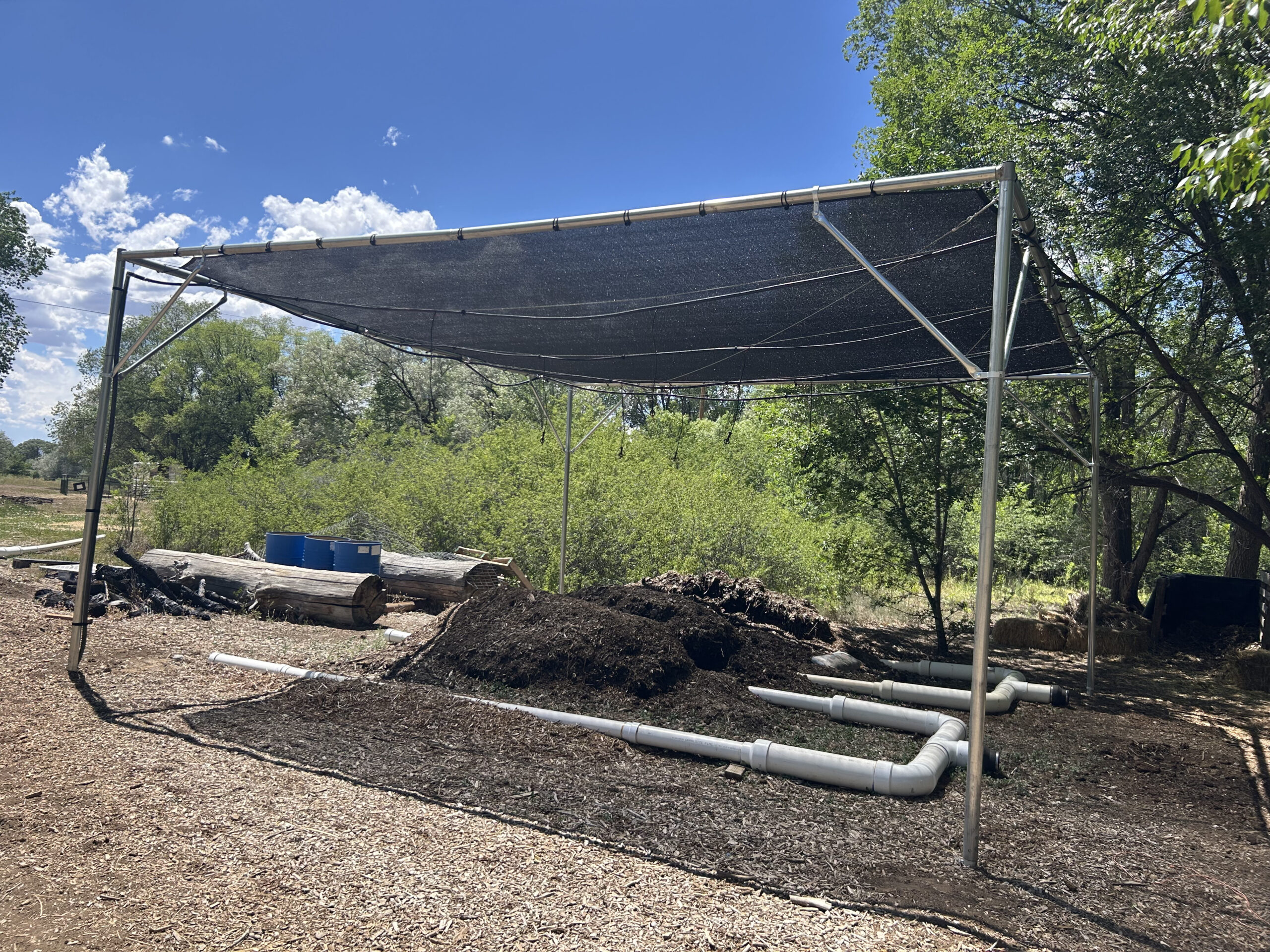
The work extended beyond water capture into soil restoration. Our Youth Conservation Corps crew assembled two aerated static compost piles and built a shade canopy over them, helping speed decomposition and turn organic waste into a resource for healthier soil.
An important focus of this project is preparing for a transition in how water is applied in our back fields. Materials have been purchased for an acequia-powered sprinkler system with two movable sprinkler setups and a Honda pump that will help distribute water across 2.5 acres of degraded rye fields. This shift away from flood irrigation increases the efficiency of our acequia water in a hotter, drier climate and helps ensure more even distribution across the fields.
Although a lack of acequia water meant the full system could not be put into practice this season, the infrastructure is now in place, and we are eager to begin using it next year to make better use of every available drop. A cover crop has already been planted in the rye field where germination failed last fall, helping begin the process of rebuilding soil in advance of that next phase.
Support Water Conservation
This grant may be concluding, but the larger work is not. Rio Fernando Park remains part of a long-term community effort to restore wetlands, revive agricultural land, and strengthen the future of acequia stewardship in Taos. Your support helps carry this work forward. A donation to Taos Land Trust invests in water conservation, soil restoration, youth stewardship, and the long-term future of farming along the Rio Fernando.
Reduce fire risk and turn brush piles into mulch by scheduling a woodchipping visit with our partner farmer, who now provides on-site chipping using Taos Land Trust equipment. Partial cost assistance is available for qualifying landowners, so call today to book a field visit.