An excerpt from Wendell Berry’s “Manifesto of the Mad Farmer Liberation Front”:
Ask the questions that have no answers.
Invest in the millennium. Plant Sequoias.
Say your main crop is the forest
That you did not plant,
That you will not live to harvest.
Say that the leaves are harvested
When they have rotted into the mold.
Call that profit. Prophesy such returns.
Put your faith in the two inches of humus
That will build under your trees
Every thousand years.
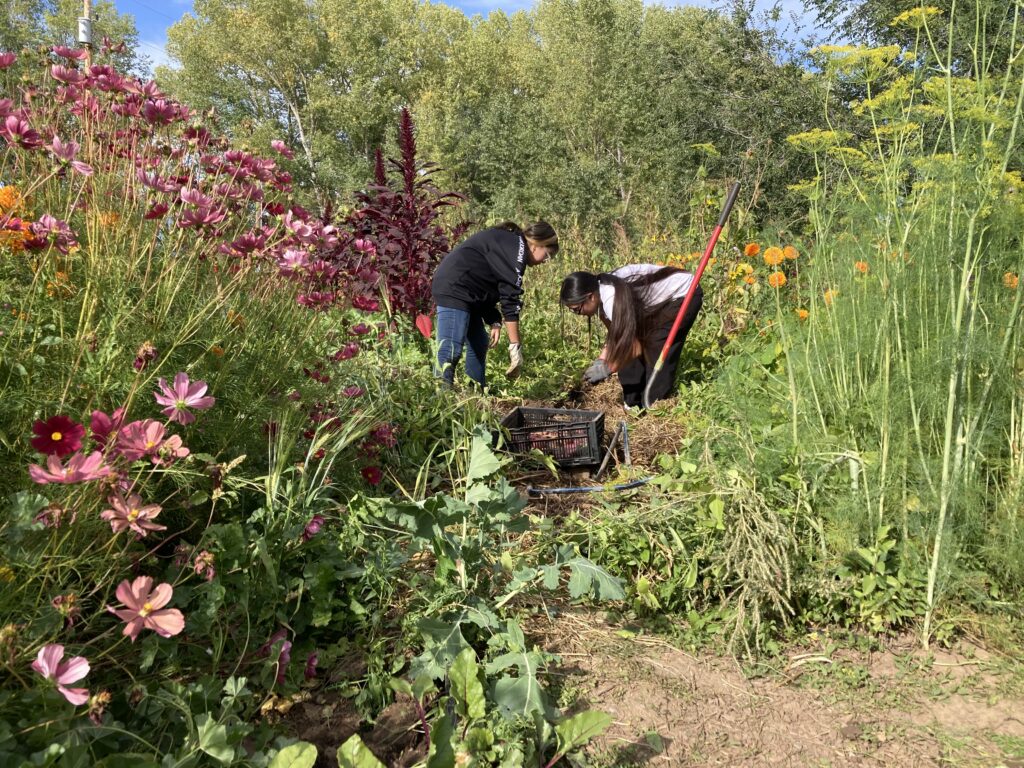
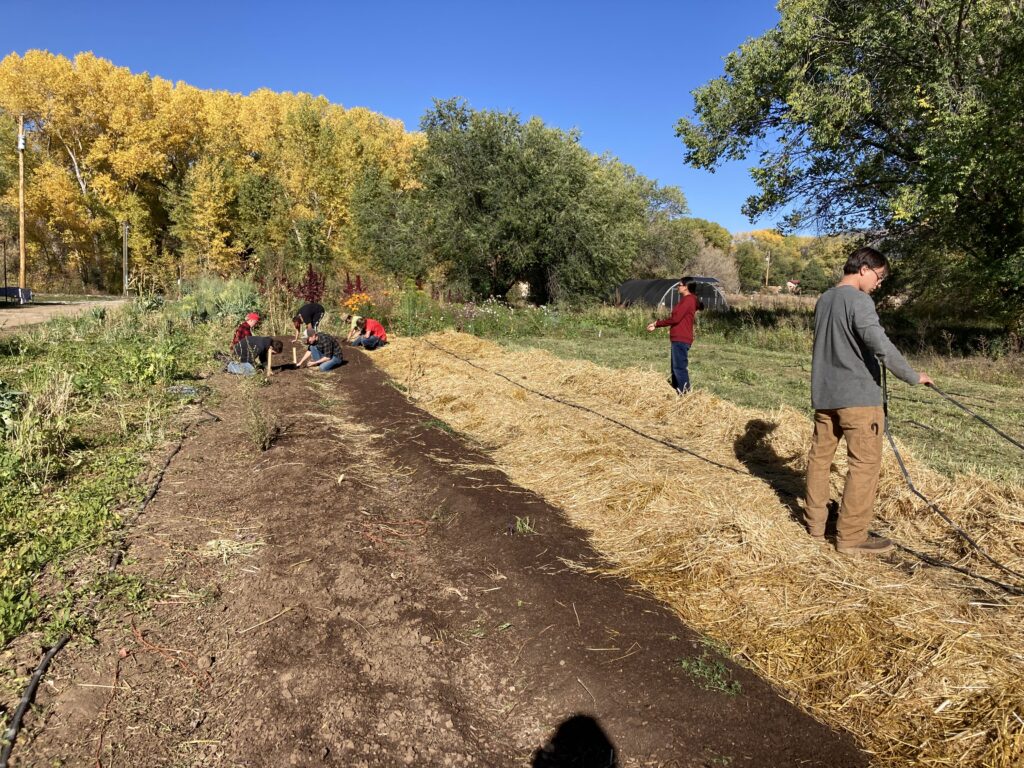
Rio Fernando Community Farm is composed of many interconnected parts. Individuals and families can rent garden plots in our Community Garden, tending their own food and flowers. Students and apprentices take on leadership roles and grow thousands of pounds of food each year for the greater Taos community in our Educational Gardens. Our Community Composting Center transforms donated food scraps into microbially rich compost that feeds the soil. Our Food Forest puts permaculture into practice with diverse, layered plantings. New in 2026, our Animal Stewardship Program will introduce goats and turkeys to help restore soils, manage pests, and reduce noxious weeds. We’ll also be breaking ground on a new Children’s Garden, a whimsical space where children and their families can play, explore, and connect with the land.
OUR FARMING ETHIC
When we look at the land and think about the community it serves, we look beyond a human‑centric definition of community. We mean the entire biotic community, from microorganisms in the soil to the birds passing through on their migrations. We are also thinking of those who have come before us and those who will belong to this land‑community for generations to come. As we embrace this holistic view, we do our best to consider the needs of all species, including our own. We therefore see agriculture here as a way to:
- Mitigate future climate change impacts and respond to the effects already visible on the land.
- Build resilience in agricultural production through soil health, water conservation, and a mix of new and old food‑growing methods rooted in local knowledge and adapted to our high desert climate.
- Create opportunities for people of all cultures and livelihoods to share knowledge, labor, food, and the celebrations that arise from shared culture and work.
- Engage holistically with the broader agricultural community of Taos County and the region, supporting and amplifying efforts already underway rather than competing with them.
AGRO-ECOLOGIC PRINCIPLES
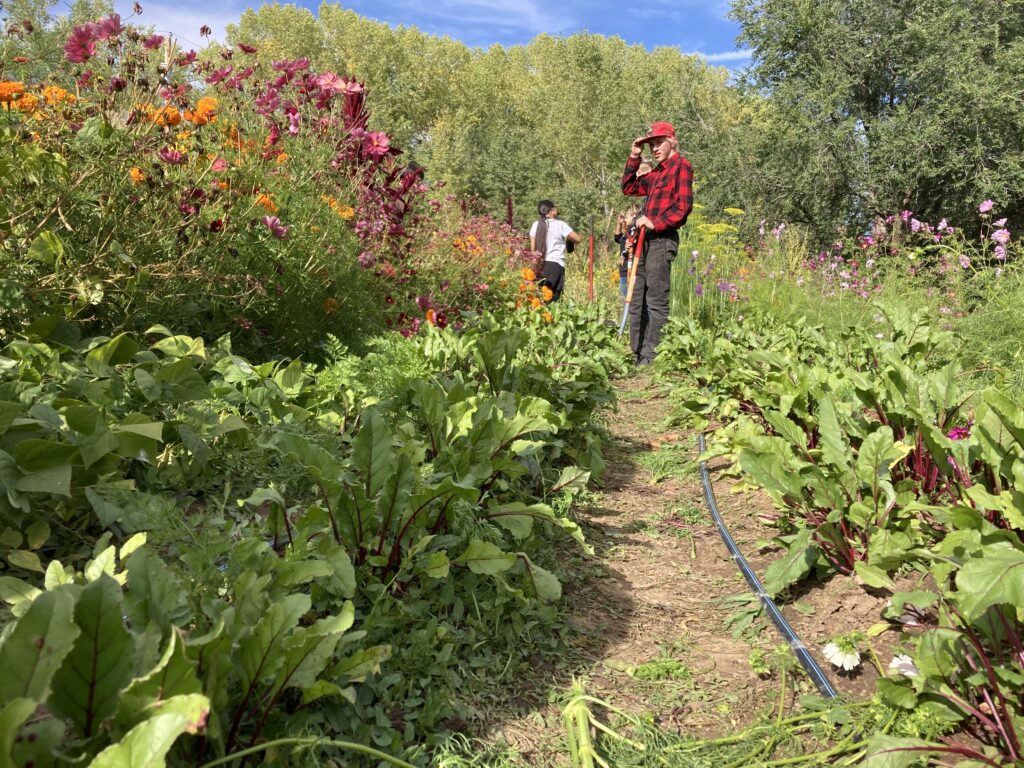
Sustainable and regenerative agriculture rests on the foundational principles of agro‑ecology, which understand farming as inseparable from ecological health and wellbeing. Through a regenerative, agro‑ecologic lens, the focus expands beyond yield to include the long‑term sustainability of the whole system. At Rio Fernando Park, our programming is less concerned with maximizing output and more focused on using agriculture to restore the health of the land‑community.
The agro-ecological approach is guided by six basic principles:
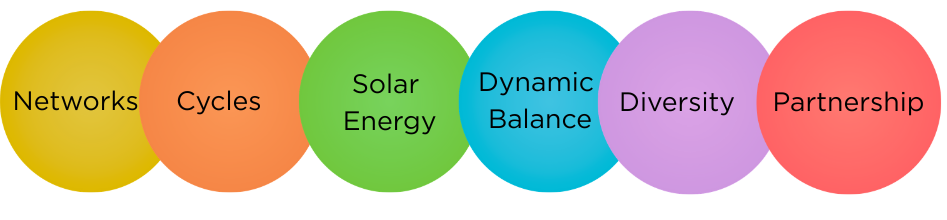
Guided by these core agro‑ecological principles, our approach aims to optimize nutrient availability, maximize recycling of biomass and materials, and balance nutrient flows across the system. Using regenerative methods such as rotational grazing can increase the soil’s water‑holding capacity and overall water retention, which in turn supports groundwater recharge and reduces runoff across the property and surrounding ecosystem. Diverse agricultural plantings support wild biodiversity by providing complementary habitat for plants and animals. Agro‑ecological systems not only strengthen the ecological health of Rio Fernando Park, they also benefit downstream ecosystems through flood mitigation and improved water quality.
FARMING FOR COMMUNITY
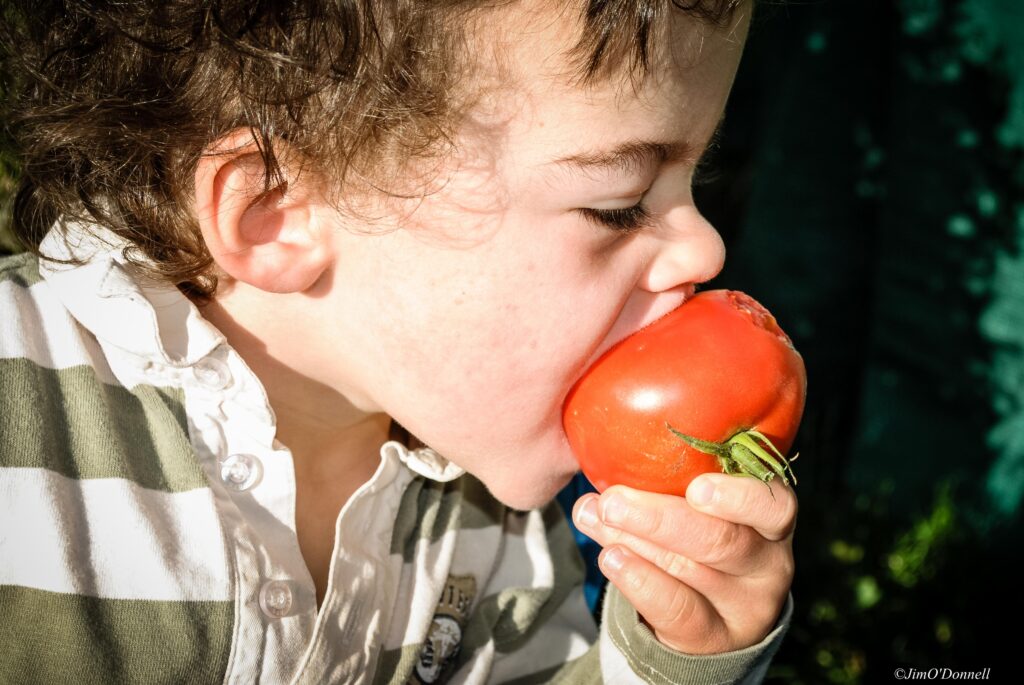
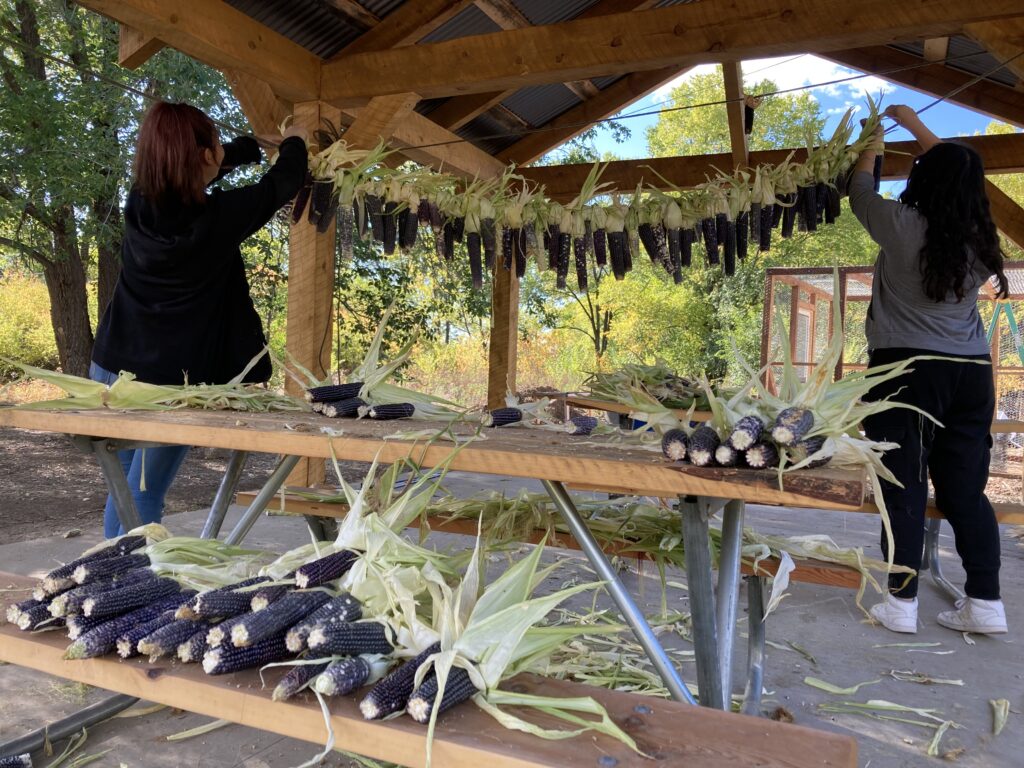
Our agricultural work at Rio Fernando Park goes beyond food and fiber production. In a multi‑functional agricultural system, the benefits are environmental, cultural, social, and economic, extending well past the farm fence and into the wider community. Through community events, volunteer days, internships, and youth workshops, we want our farm and garden spaces to build social capital, create bonds, spark conversations between strangers, generate jobs for young people, and encourage innovation.
“One of the best ways to heal the divides in our communities…is to work hand in hand to heal the land…by doing so we can reduce the depths of the divides in our communities, not just the gullies in our landscapes. And when we have done so, we can then celebrate our work around a shared table with the fruits of our labors.”
– Gary Paul Nabhan (2018)
THE ROOTS: HISTORY OF AGRICULTURE IN TAOS COUNTY
Taos Pueblo is among, if not the, longest continuously inhabited communities in the United States, with ancestors of today’s Pueblo people settling permanently in this valley over a thousand years ago. That settled life emerged hand in hand with cultivation and irrigation of the land. Gravity‑fed systems from the Rio Pueblo and Rio Lucero watered fields that could both feed the Pueblo and provide surplus for trade. Agriculture at Taos Pueblo flourished into the 1940s and, to this day, agrarianism and land stewardship remain central to Pueblo culture and identity.
The legacy Hispano community has been farming in the valley for over three hundred years, with villages lining the tributaries of the Rio Grande and expanding as acequia systems extended arable land. These gravity‑fed irrigation ditches linked water, land, community, religion, governance, identity, and survival. As ditch systems expanded, communities grew, and the ritual of sharing water nurtured stories of interdependence. Northern New Mexico’s isolation, limited exports, and minimal government support from Spain, Mexico, and later the United States meant Pueblo and Hispano families relied almost entirely on local land and water well into the twentieth century.
For Taos Pueblo, the struggle to maintain traditional lands, waters, and agricultural practices began with Spanish colonization. The Spanish Crown confined their broader concept of usufruct rights to a smaller land grant, a reduced version of which defines Pueblo lands today. As the non‑Pueblo population grew, weak enforcement of Pueblo boundaries and shrinking irrigable land encouraged encroachment onto Indigenous lands, further degrading Pueblo control. Later, the Indian boarding school era removed children from their families and communities, cutting them off from language, ceremony, and agricultural practices that had sustained their people for generations. The Second World War then drew nearly a third of Pueblo people into military service or war‑related industries, while the cash economy increasingly replaced subsistence, pulling people from their fields and into wage labor and tourism.
As U.S. colonization and policy marginalized both Pueblo and Hispano communities, a shared sense of disenfranchisement emerged alongside mutual dependence. Today, Taos Pueblo retains some agency over its territory as a federally recognized sovereign nation with land that cannot be sold outside the Pueblo, and with federally recognized water rights that are primary to other users. The legacy Hispano community, by contrast, has not been granted even this limited level of agency over historic land grants. Over generations, Hispano families divided land among descendants, resulting in smaller, overused parcels that could no longer sustain households. Communal grazing lands were often lost through dubious legal maneuvers by distant lawyers and developers, without the consent or knowledge of most community members. Much of that land passed to federal agencies whose management, though intended to restore overused landscapes, often failed to respect cultural land‑use practices and relied on incomplete science, undermining both the land and the subsistence livestock economy.
A convergence of factors–statehood, the rise of a wage economy, railroads bringing cheap commodities, and the World Wars that drew many men away–fundamentally reshaped community life. Traditional knowledge transfer between generations declined, the land could no longer fully support local families, and rising land prices pushed people away from daily, land‑based agricultural life that had long formed the heart of culture and identity.
Today, private water rights can be legally separated from land, something once unthinkable in a region where people say, “sin agua la tierra no vale nada,” without water the land is worth nothing. The ability to sell acequia rights off local land to downstream cities, the state, or developers leaves fields without the water needed for agriculture. This threatens the existence of el paisaje del agua, the green, irrigated landscape that defines north‑central New Mexico.
NEW FARMERS AND SHIFTING IDENTITIES
Although agriculture no longer dominates the economy or daily routines at Taos Pueblo or in the legacy Hispano community, it remains central to cultural identity in both. Efforts to revive and celebrate these agricultural roots are growing. At the same time, many predominantly Anglo newcomers drawn by the Back to the Land movement and later sustainability movements have helped build a community of new farmers practicing organic and regenerative agriculture. Some of these practices draw on ancient techniques, some are recently developed, and many originate outside local geographies and long‑held traditions.
In recent decades, the Hispanic population in Taos has also grown through people whose roots lie in more recent migration from Mexico and other parts of Latin America. Whether they are newcomers or the children and grandchildren of immigrants, many bring their own histories of subsistence and market agriculture, along with living traditions of kitchen and market gardens.
If we are to maintain the agrarian identity of our cultures, protect and revitalize our agricultural lands and waters, and support long‑term food security, we must create public opportunities to celebrate farming traditions, share knowledge, and invite youth into agricultural life. Our hope is that Rio Fernando Park, centrally located and situated on historically agricultural land, can serve as a platform for agricultural learning, discourse, and celebration.